Medication Workflow: The Efficiency Metric Most ASCs Still Aren't Tracking
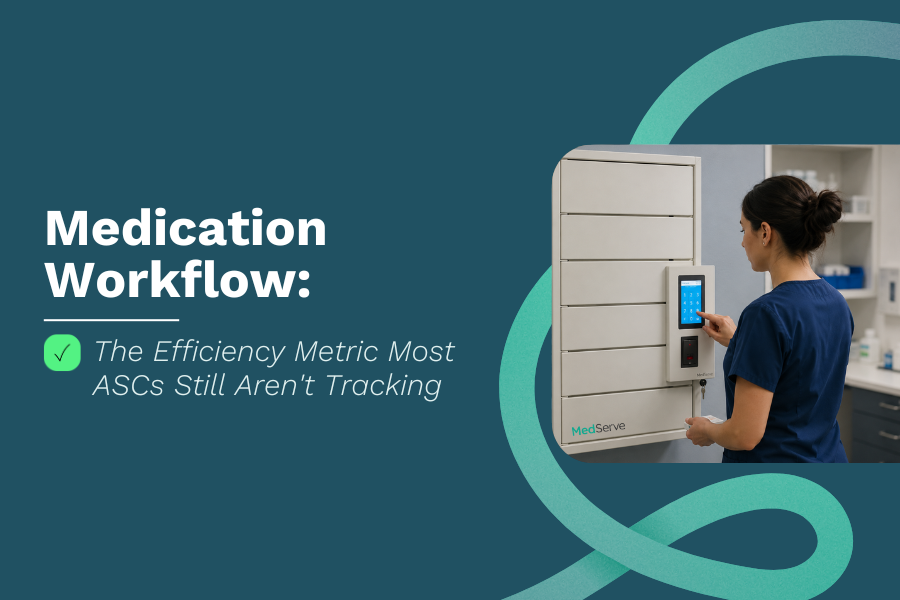
Walk into any ASC running six cases on a Tuesday, and you'll find a team that has turnover time, prep sequencing, and case order worked out to the minute. That's just how ambulatory surgery works. Small teams and back-to-back procedures don't leave room for guesswork, so administrators track everything that touches throughput.
Medication workflow rarely makes that list. Not because it doesn't matter, but because most centers don't measure it the same way they measure turnover, staffing, or case times. It just runs the way it always has, in the background, while attention goes to the parts of the day that show up on a report.
That's worth a second look because most administrators have already made meaningful improvements to scheduling. The next opportunity to improve efficiency may be hiding in the small medication-related steps that happen between cases, during shift changes, and at the end of the day.
None of these steps looks like a problem by itself: a walk to the medication room, a quick narcotic count, a few minutes reconciling numbers before heading home. Someone is spending that time, even if nobody is measuring it. Over the course of a day or week, those minutes quietly add up, especially in ambulatory surgery centers running eight or ten cases a day with a small team and limited backup. Here are five places worth a closer look.
1. The walk to the medication room
It's the third case of the morning, and the circulating nurse needs a medication that isn't at the point of care. In a lot of centers, medication access lives in one central location, which means stepping out of the room, walking there, and walking back, interrupting care in the middle of a case.
Many ambulatory surgery centers still store medication this way because that's how the room was set up years ago, when a center might run half as many cases in a day. The setup wasn't built for the pace of today's ASC. Many centers have simply outgrown it.
Now multiply those thirty seconds by every trip staff make throughout the day. In a center with no float staff to cover the room while someone's away, that walk isn't just lost time, it's a gap in coverage. None of it shows up on paper. It's just built into how the day runs.
2. Waiting on keys or a specific person for cabinet access
Not everyone on staff is credentialed to access controlled substances, and that's by design. But with a smaller team, it also means cabinet access can depend on one particular person being in the building and not currently tied up in another case. If that person is busy, everyone else waits. It's not only about one person, either. When several rooms share the same cabinet, more than one case can need access at the same time, and only one room gets to go first.
A nurse ready to prep the next patient must stop, track someone down, and get back into rhythm once access happens. Multiply that across a day with several staff members needing access at different points, and those short waits start shaping how quickly cases turn over, even though none of it counts as turnover time.
3. Manual narcotic counts eating into the shift
Shift change in an ASC rarely lines up with a clean break in the schedule. It usually lands mid-day, which means someone has to stop, count controlled substances by hand, check it against a log, and get a second signature before moving on.
It has to happen. But doing it manually takes real time out of every shift, and it leaves room for the kind of small error, a transposed number, a missed line, that turns a routine count into a longer investigation later, usually at a moment when nobody has time to spare for one.
4. Searching for a medication that should be there and isn't
A missing vial doesn't announce itself. It shows up as a number that doesn't match, discovered by whoever happens to be doing the count at the time. Was it used and not logged? Miscounted? Sitting in a different drawer than usual?
Without a clear picture of what's already been used, discrepancies don't surface until after the fact, when whoever's counting must stop and figure out why the numbers don't match. That search pulls someone away from patient care at exactly the moment they're needed elsewhere, and it tends to happen on the busiest days, when the schedule has no room to absorb it.
5. End-of-day reconciliation that lands on a tired team
By late afternoon, the last case is closing, and whoever's responsible for closing out the day is running on the same energy they had at six that morning, which is to say, not much. Someone still has to tally what was used, what's left, and what needs to be reordered, often by hand.
It's the kind of task that gets rushed or handed off to whoever's closing up, which makes it the one most likely to introduce a small error that surfaces days later as a mystery someone else has to sort out. It also tends to live in one person's head instead of on paper. When that person is out sick or moves on, the center finds out fast how much informal knowledge was holding the process together, and a new hire ends up reconstructing workarounds nobody ever wrote down.
Why these slowdowns don't show up on a report
OR turnover, first-case start times, case length: all of it gets measured because ASCs have built the tools to measure it, and because there are industry benchmarks to compare against. ASC medication workflow doesn't have anything like that. Nobody's dashboard flags a nurse's extra trip to the medication room or the ten minutes spent tracking down a key.
That's exactly why these slowdowns are easy to miss. They don't trigger an alert or show up as a red number in a monthly report. They just pile up, shift after shift, until someone times the process and sees how much of the day medication handling accounts for.
What efficient medication workflows have in common
The most efficient medication workflows usually have a few things in common.
Staff know what's on hand without relying on memory or a count sheet. Medication access happens where care happens instead of down the hall, so nobody is leaving the room mid-case to retrieve what they need. It's clear who accessed what and when, without anyone having to piece it together later.
The process stays the same whether it's Monday or Friday, whether it's the nurse who's been there ten years or the one who started last month. And the parts of the job that don't require clinical judgment, like counts and access logs, aren't eating up someone's shift by hand. That leaves more time for patient care and fewer interruptions throughout the day.
None of this requires overhauling how a center operates. The goal isn't more complexity. It's removing interruptions that don't need to be there.
Questions worth asking
A few questions can help surface where the time drains actually live in your center:
How many extra steps does a staff member take in a typical day just to access medications?
How often does cabinet access depend on one specific person being on site and available?
How long does a shift-change count actually take, start to finish, and how often does it turn up a discrepancy that has to be chased down?
When did staff last spend unplanned time searching for a medication or reconciling a number that didn't add up?
How much of your end-of-day documentation is still done by hand, and what would change if it wasn't?
The answers tend to be more revealing than expected. Once administrators actually time the process, medication workflow often turns out to be eating more staff hours than anyone assumed, hours that never show up on a turnover report.
The takeaway
Scheduling and staffing get attention because ASCs have spent years building ways to measure them. Medication workflow hasn't gotten that same attention, not because it matters less, but because it hasn't traditionally been measured the same way.
A center can turn over a room in record time and still lose that time back at the medication cart, the locked cabinet, or the closing count. If someone asks how efficient your ASC really is, turnover is only part of the answer. The other part is how easily your team can get the right medication to the right place, at the right time, without interrupting care.
Curious where your center's medication workflow stands?
Schedule a quick call to see how MedServe brings medication access closer to where care happens.